By Dimitrios Otis-contributing
writer, Vancouver Courier, 08/31/2005
Downtown
Granville was once dominated by movie theatres, pinball arcades,
and sex shops. They are slowly disappearing, replaced by nightclubs
and bars, as Granville transforms into a booze-based "Entertainment
District." Many other businesses have gone under recently. But
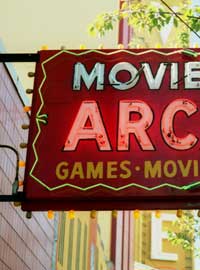
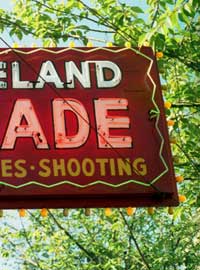
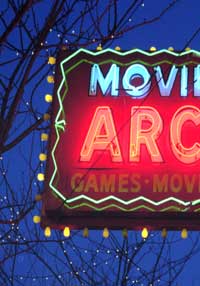
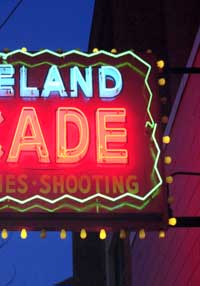
one longtime enterprise that refuses to die is Movieland Arcade,
which fits all three classic diversions under its roof. The pinball
and video games are up front, but tucked away in the back is an
amalgamation of celluloid and sin that some film advocates believe
belongs in a museum.
You see,
Movieland Arcade at 906 Granville St. is the last home of authentic,
8mm "peep show" film booths in the world.
"That surprises
me, and I know everything that's going on." The voice on the phone
is Tony Perry, and when it comes to the adult entertainment industry
in B.C., his is no idle boast. Perry was the forerunner of adult
book and film distribution here, and has been in the business
for close to half a century. Equity magazine once dubbed him "Vancouver's
Granddaddy of Porn." But Perry is genuinely taken aback to learn
Movieland Arcade is still running peep shows with old films. "Why
the hell would he still keep going? I would be stunned if he's
making money. Jack is an anachronism."
The "Jack"
that Tony Perry is referring to is Jack F. Jung, the man who opened
Movieland 33 years ago, and still owns it today.
Perry admits
he never got to know Jung, despite being in the same business
for several decades. I soon learn why. Jung is extremely secretive.
Most workers at Movieland claim never to see him, and will only
refer to him as "the owner," even after I repeat his full name
several times.
Perry owns
stores with peep show booths, but they are all modern video shown
on television monitors. He tells me the last time he ran film
in a booth was 25 years ago. "I stopped because you couldn't buy
product." Perry is bemused that someone would still show film.
"So that man is totally living in the past. Isn't that amazing?"
I wonder
too-but my request for an interview with Jung, submitted through
a Movieland employee, is denied.
Perry comes
up with an interesting comparison for Movieland: "It's like going
back and seeing the Civil War with the original cast," he says.
The analogy
is more apt than you'd think. The American civil war ended in
1865. Twenty-eight years later Thomas Edison unveiled the Kinetoscope,
the first machine to show moving pictures on film. The short film
ran inside a large wooden box, and was viewed through a magnifying
lens set in an opening at the top. Coin-operated, the entertainment
device was wildly popular for a time, and became known as a "peep
show," because only one person could watch at a time by "peeping"
through a little window. The Kinetoscope's private cinematic thrill
survives today in the coin-operated wooden booths at Movieland
Arcade.
But as the
novelty of the Kinetoscope and similar peep shows wore off and
film projected on to large screens appeared, promoters began building
what were first termed movie palaces. Vancouver got its first
in 1910, the Maple Leaf Theatre at 877 Granville St. Peep shows
were relegated to amusement parks and fairs. There they would
have stayed, except for the sexual revolution several decades
later. Part of the "free love" movement of the 1960s and 1970s
was increased freedom to see provocative images. In 1966, entrepreneurs
in the fast-growing pornography market hit upon a bright idea.
The story goes that one or more shady characters came across an
old peep show machine on their distribution routes. Peep shows
had always been secret havens for risqu‚ film, but these guys
put the newly legal sex movies in them. Part of the brainstorm
was encasing the film apparatus itself inside a cubicle, so the
watcher had privacy.
The new
peep shows were a huge hit, spreading across North America and
becoming one of the biggest moneymakers in the world of commercial
sex product. In the peep show heyday of the mid 1970s, infamous
Times Square arcades like Peepland and Peep-O-Rama ran hundreds
of machines day and night.
Then the
Times Square sleaze-mongers upped the ante by putting "Live Nude
Girls" in booths, a concept which wasn't allowed across the border
into Canada. British Columbia didn't even permit fully "hardcore"
film material until 1983. But demand for the "soft" stuff we could
see was enough so that when Jack Jung opened his arcade in 1972,
peep show movies were the key offering, as the name of his enterprise
made clear.
And now
it's a part of film history.
"I really
liked that neon sign. I saw, 'Movieland', and wondered, 'What's
that?'"
Allan "Fishsticks"
Harris had recently arrived from Ontario when curiosity first
drew him into Movieland Arcade during the summer of 1989. Now
a university grad and family man living in Port Coquitlam, Harris
is returning to check out his old haunt.
"I pretty
much started going regularly," he says about the old days. "Even
then, this was the only place with actual movies." Harris taps
on the booth, eliciting a hollow sound from within. "You could
hear the faint clickety-clack of the projector inside. That clicking
sound made you feel you were in a different world." As I enter
the arcade with Harris, I get a sense of that different world
right away-and it exists a few decades in the past.
The place
can't have changed much since it opened. Part way down the long,
cavernous room, a huge, hand-painted sign hangs from the ceiling.
It stretches across the full width of the building and reads,
in classic 70s shades of yellow, orange, and brown, "Girlie Movie-Theatre
for Men."
We walk
past the sign, past the vintage '80s Casino Strip video game,
and all the way to the back. There stand several banks of nondescript
wooden booths, painted a dull grey. These are the last of the
movie peep shows, far removed from Times Square. They are not
much to look at, but it's what's inside that counts.
Harris points
out a tiny red bulb on each booth, which lights up when the film
is running. I notice a metal plate on the front of the booths,
with a succinct description of the film scrawled on it with a
magic marker: "two girls and guy," or "lesbians." Also written
down is the date the film was put in. Who changes the movies,
I wonder?
To watch
a movie, you squeeze sideways and uncomfortably into the narrow
opening in the booth. There's a coin slot and a rectangular window
at eye level that measures 1-1/2" by 4". Through it you can see
a square piece of white paper tacked up inside. This is the movie
screen. If that seems a glorified term, it is worth noting that
each of these homely grey booths is a separate, provincially-licenced
movie theatre. Steven Pelton, of the B.C. Film Classification
office, tells me the booths are officially labelled "one-person
only" theatres. That makes the Movieland a ten-plex cinema. It
beats the new Paramount Vancouver by one screen.
The province
may call them theatres, but the City of Vancouver describes the
booths in its licence bylaw more frankly as "pornographic film
viewers." During an interview, chief licence inspector for Vancouver,
Paul Teichroeb, uses the more discreet term "private viewing booths."
But the award for best official label goes to our namesake city
south of the border. In Vancouver, Washington, the civic government
formally describes this type of theatre as a "sexually-oriented
adult arcade device."
"I can't
believe that they still run scratched and faded 1970s film loops
in 2005," says Andrew Lampert, an historian with the Anthology
Film Archives in New York City, a film museum founded in 1969
by renowned avante-garde filmmakers Jonas Mekas and Stan Brakhage.
"It is really incredible to see that the screens are simply white
pieces of paper hung with thumb tacks. I'm really amazed."
Lampert
is in Vancouver attending an annual conference of the Association
of Moving Image Archivists (AMIA) when I direct him to Movieland
for an expert opinion. His subsequent email gushes: "A definite
highlight of my trip. Culturally and historically I think it is
a dinosaur standing on one leg. I took a few of my colleagues
along and we were all overly excited that they still maintain
loop projection."
"Looping"
refers to the unique method of showing film that peep show devices
have used since the 1893 Kinetoscope. Because no projectionist
rewinds the film, the movies in peep shows run continuously with
the end of the film attached to the beginning. The film is essentially
one big loop. The projector needs a special attachment to hold
and run the loop-think of an old 8-track tape, which can play
over and over, but is coiled up inside the case. Lampert cautions
that this is not a simple technical feat.
"Loop projection
is a tough thing to pull off, and I've got to assume they have
someone regularly taking care of the film." But after several
phone calls and visits to Movieland, the only possible maintenance
person I can find is a young man named Les, who says he is the
manager. Les admits he knows nothing about film. "I'm just here
every so often if they need me to do some extra work." He shrugs.
Les won't say anything more without permission from Jack Jung,
and a list of questions I submit to Jung through Les go unanswered.
I conclude
that Jack Jung must still be fixing those tricky Kodak loop mechanisms,
and splicing the films when they break. I begin to picture him
secretly handling the old celluloid and the vintage projectors,
as if Movieland were his own little Cinema Paradiso. Hoping to
encounter the mysterious Jung at his arcade, I make several visits
near
closing.
But only Les ever shows up. I finally try calling Jung at his
home in Shaughnessy. A woman with a cheery voice answers. I ask
to speak to Mr. Jung. After a long wait a man comes to the phone.
His elderly voice is initially friendly, but after I mention my
purpose he just says he is "not interested," and hangs up.
"I tried
to talk to the owner once, when the door to the film room was
open," says my Movieland tour guide Allan Harris. He points to
a locked, yellow door behind the booth section. "It looked like
he had a couple of hundred little movie reels in there. There
was a winding-viewing apparatus on the table. I tried to buy one
of the films, but he just refused outright."
Harris says
when he patronized Movieland the booths had little doors on them.
"One day the doors were just gone." During my quarter-fuelled
tour, I enter one booth in a corner showing a very reddish loop
with performer hair styles that indicate an early '70s film date.
The next booth has, surprisingly, a bisexual scene. Then I find
the legendary John Holmes in action, in a silent loop that has
been given subtitles, as if they are needed.
"Nice_and_easy"
the subtitles helpfully read, as the young Holmes demonstrates
his talents. Then, "faster_FASTER!!" These short films, or "loops,"
were made especially for peep shows back in the day. Harris says
they run eight to 10 minutes in length, or $2 if you measure in
quarters.
But in the
early 1980s, the golden age of film booths came to a sprocket-tearing
halt. The industry switched to video and never looked back. As
the old projectors broke down they were retired, and the loops
had a limited shelf life. Besides the fading and the "magenta"
effect of age, they became scratched and broken from continuous
play in the loop mechanism. Porn producers stopped making short
films altogether by the end of the bad-hair decade. It was the
end of an era. But for some reason, Movieland never converted
to video, and it did not close down.
Tony Perry
recalls approaching Jung sometime in the 1980s about "updating
and modernizing his arcade." According to Perry: "Jack said, 'No,
no, no! Not interested. Thank you, good bye.' And that was that."
So while the porn world turned, Movieland Arcade quietly continued
to show its retro film collection in the old wooden booths.
In the fall
of 1979, a local R&B band stands on the Granville Street sidewalk
to pose for a group photo for their self-produced debut album.
Photographer Denise Grant bounces a strobe light off the sidewalk
and on to the seven musicians lined up in front of... where else?
Movieland Arcade. The album goes on to sell almost a million copies,
and includes a little song "Doin' It Right (On the Wrong Side
of Town)." The band was the Powder Blues, and, like the Movieland,
they are still around and kickin' it old school. Lead guitarist
and founder Tom Lavin happily reminisced to me recently about
the location for the shot: "Yes, that was my idea, outside the
Movieland Arcade. A great sign and a great location; so like the
blues... electric yet dingy."
On a recent
sunny day in 2005, the doors to Movieland are wide open, letting
fresh air into the still-dingy interior. I ask the fellow who
changes loonies into quarters for the video games-or the booths-if
the movies are popular. He shakes his head with dry amusement,
quietly stating "maybe one person a day watches." Allan Harris
notes the lack of customers for the film loops is not a recent
development. "Even then it was never busy. There was hardly anyone
around the booths."
Movie houses
are almost gone from Granville Street, which used to be known
as "Theatre Row." The Plaza, Caprice, Paradise, Granville Centre,
and Capitol 6 theatres have all closed for good. Even the long-established
(but video-showing) Kitten adult theatre was finally felled by
a wrecker's ball. But Movieland Arcade has kept going through
all this. Its longevity is curious, especially considering that
Jack Jung also owns the Movieland property and could sell it for
a handy profit. For Tony Perry, though, the question is not what
will happen to Movieland. "What is intriguing is why is Jack still
running those movie booths?" Vancouver's granddaddy of porn just
can't figure it out.
The enduring
magic of film regularly flickers out from a 35mm projector at
beloved film palaces such as Vancouver's historic Ridge and Hollywood
theatres. But for one unseen theatre owner, some magic must still
trickle out from old 8mm projectors encased in wooden boxes, in
an antiquated tradition that he alone keeps alive, and calls Movieland.