 |
 |
 |
 |
 |
 |
 |
 |
 |
 |
|














|


 |
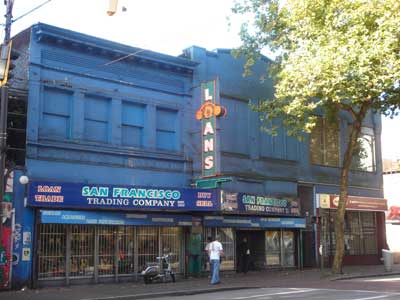
San Francisco Trading Company - Vancouver, A family run business, established in 1908. It began as a Clothing Store, with cleaning and pressing as well, and slowly evolved into the Full Service Pawnbrokers Business. Property purchased by Concord Pacific for development of condominium project in 2008. Demolished 2009. |
Downtown Eastside (Vancouver) community members and housing advocates gathered April 22nd, 2008 to hold a consultation that they say the City of Vancouver was legally required to do, but didn't do, on a new condo project in the neighbourhood. "The City of Vancouver may have been trying to sneak this proposal past us, suggesting that 154 condos in the first block of Hastings Street East isn't a major project that requires consultation," said Wendy Pedersen of the Carnegie Community Action Project. "We disagree, and we're going to hold our own consultation on what the neighbourhood wants to see on that site." The consultation concerns a lot at 58 West Hastings Street owned by Concord Pacific, Canada's largest developer. The proposed project is a seven storey condominium project called "Greenwich," which proposes 154 market housing units, from two-bedroom to studio units. No social housing or other community amenities are currently proposed to be located on the site. Rick Michaels, the Director of Planning delegate for the City of Vancouver, has already apologized for what he calls an "inadvertent shortfall in the notification process for this application," and an "incomplete notification process." "This project got a rubber stamp from the city, even though it doesn't comply with the DTES housing plan," noted Pedersen. "How can the City approve this project without talking to the elected officials that set the plan, or the community that relies on that plan?"
|
 Info
courtesy of Carnegie Community Action Project
Info
courtesy of Carnegie Community Action Project| Condo
project would fuel 'class hatred,' activists say Fearing it would hurt the poor, demonstrators want proposed development quashed WENDY STUECK The Globe June 25, 2008 VANCOUVER -- As Vancouver activists battle a proposal to plunk high-priced condominiums on the city's skid row, another debate is humming in the background: whether such developments could help revitalize the neighbourhood without displacing low-income residents. That's the position taken by the city, which says developer Concord Pacific's proposed Greenwich condominium project at 58 West Hastings is consistent with policies that call for a mix of housing types in the Downtown Eastside, and require any low-income units lost as a result of development to be replaced on a one-to-one basis. Restricting private development won't necessarily protect low-income housing or its most vulnerable residents, heritage consultant Donald Luxton said yesterday. "Do we really want it as an unbalanced area of nothing but social housing? I don't think there's even a lot of housing advocates that would say that," Mr. Luxton said, adding that even at prices of $400,000 or higher, the new condos would be affordable to some. While supportive of a mix of housing types in the neighbourhood, Mr. Luxton echoed activists in pointing to a dire shortage of affordable housing in the Downtown Eastside and the pressure that soaring land values and property speculation has placed on the neighbourhood. The Carnegie Community Action Project and other groups are calling on the city to block Concord's proposal for a seven-storey, 160-unit condominium development on a stretch of West Hastings near several social housing projects. Opponents say the project would drive up rents in the Downtown Eastside and is part of a trend that saw new market housing being built three times as fast as social housing between 2003 and 2008. As well, hundreds of single-occupancy rooms have been lost to "soft conversions" of hotels to student-only accommodation or daily or weekly rentals. The city maintains the one-to-one replacement policy is being met, but housing activists say the city is fudging the numbers by including rooms in hotels bought by the province as new, non-market housing. As protest signs spring up around the Concord site, billboards are appearing for Downtown Eastside developments, some on blocks that would have been considered out of bounds for condominiums a few years ago. "A lot of more established developers are looking to the Downtown Eastside with a great deal of interest," said Nick Bromley, a geography professor at Simon Fraser University who studies gentrification and property issues. The eastward push by Concord and other large development companies does not bode well for low-income residents, he said. "Absent real development controls and absent real money for [low-income] housing, I think it signals a process of gentrification and attendant issues of displacement." |
  |
 |
All photos copyright ©
Christian Dahlberg except where stated otherwise. All rights reserved.
|